
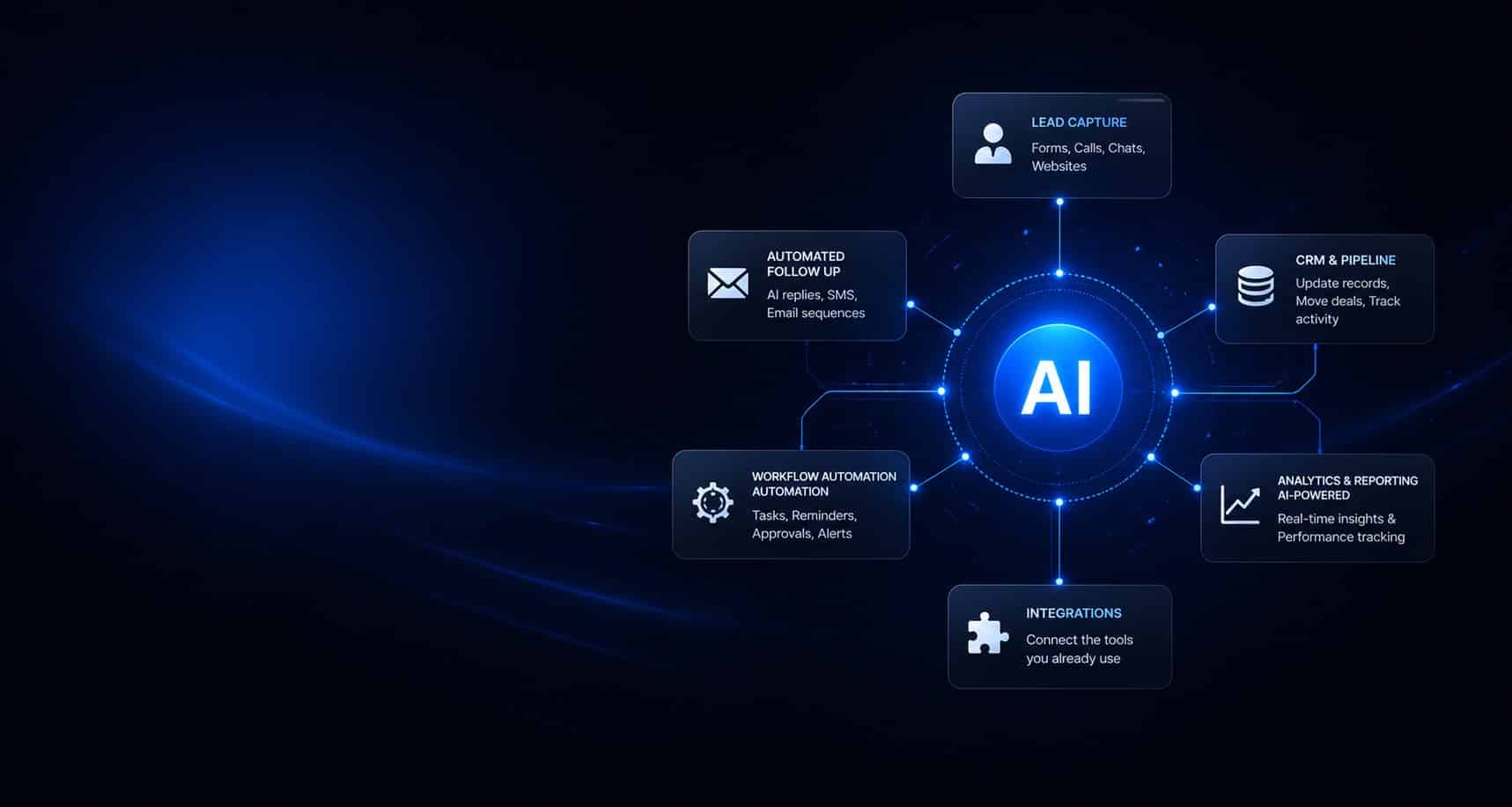
AI Automation
Stop doingwhat software should do
Lead routing, follow-up, data entry and internal handoffs, running the same way every time — whether or not anyone remembers to do them.
Where the hours go
Nobody budgets for the copying and pasting
It never appears on an invoice, so it never gets costed. It is usually the single largest recoverable expense in the business.

Work waits on someone remembering
A lead arrives, a job completes, an invoice ages. Nothing moves until a person notices and acts, and that gap is where deals go quiet.
Explore Work waits on someone remembering
The same data is entered three times
Once on the form, once in the CRM, once in accounting. Every re-entry is a chance to introduce an error that takes longer to find than it took to create.

Each tool holds one fragment
The ad platform knows the click. The site knows the form. The CRM knows the conversation. Nobody can say what a lead from a given source is actually worth.
Explore Each tool holds one fragment
Process lives in people’s heads
When the person who knows the routine is away, the routine stops. Automation turns undocumented habit into a system that runs the same way regardless.

What we build
Automation that handles the routine work end to end
We start with the sequences you run most often — the ones that happen dozens of times a week in roughly the same order. Those are where automation pays for itself first.
- Lead routing that fires the instant a form is submitted, not when someone next opens their inbox
- Records created and updated across your CRM, calendar and finance tools from a single trigger
- Assignment rules that send each enquiry to the right person by service, territory or availability
- Internal alerts by email, SMS or Slack the moment something needs a human decision
- Document and proposal generation populated from data you have already captured
- Escalation logic that chases a task when it has been sitting untouched too long

Where AI belongs
AI where language matters. Plain automation everywhere else.
This distinction decides whether a system is dependable or merely impressive. We are deliberate about it, and we will tell you when the answer is a rule rather than a model.
- AI reads unstructured enquiries and extracts what actually matters
- AI drafts a first-pass reply in your tone for a human to approve or send
- AI summarises a long thread so whoever picks it up is immediately current
- Rules — not models — handle routing, timing, thresholds and anything with money attached
- Every automated decision is logged, so you can see why the system did what it did

The result
One trigger, every system updated
A form submission should not be the start of somebody’s admin. It should be the moment a chain of work completes itself — record created, owner assigned, follow-up scheduled, calendar offered, reporting updated.
How we build it
Automate the proven path, not the theoretical one
We automate what you already do reliably. Automating a broken process only produces broken outcomes faster.
-
Audit the real workflow
We map what actually happens, including the workarounds people have quietly invented. That is usually where the biggest wins are hiding.
-
Pick the sequences worth automating
High frequency, low judgement, clearly defined. We rank by hours recovered against build effort and start at the top.
-
Build and connect
Triggers, routing, integrations and error handling, wired to the tools you already use rather than replacing them for the sake of it.
-
Test against real cases
Including the awkward ones — duplicate submissions, missing fields, out-of-hours arrivals. A system that only handles the happy path is not finished.
-
Hand over and monitor
You get documentation, access and alerting. If something fails, it fails loudly rather than silently.
Common questions
Questions worth asking
No, and we would be sceptical of anyone promising it. It removes the repetitive work around the job so the same people can handle more of it without the quality dropping.
Most do. Where one genuinely does not, we will say so up front and either work around it or tell you honestly that the integration is not worth the cost.
A first useful automation is usually live within two to three weeks. We stage the work so something is earning before the whole build is finished.
It alerts rather than failing silently, which is the difference between a ten-minute fix and finding out three weeks later. Error handling is part of the build, not an extra.
Yes. They live in accounts registered to you, and you get the documentation to run or change them without us.
That is the sensible way to start. We will help you pick the one with the best return and prove it before expanding.
Next step
Find the hours you are currently paying for twice.
A short call to map where the manual handoffs are, what they cost, and which ones are worth automating first.