The five-minute rule: why the first reply decides most service jobs
What happens to an enquiry in the minutes after it arrives, and the simplest systems that make sure someone answers.

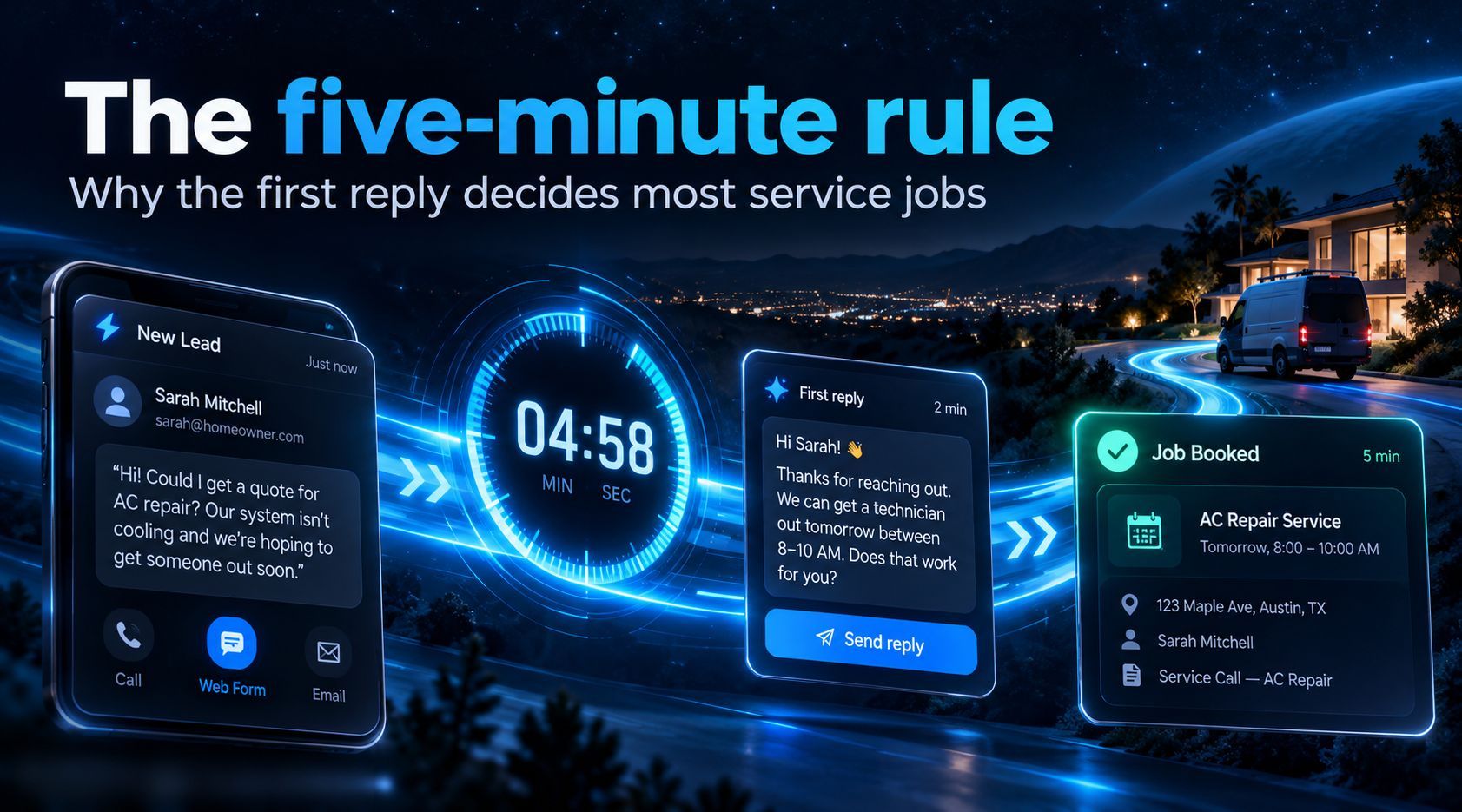
Most service businesses think they have a lead problem. When we look at their accounts, the leads are usually there. What’s missing is a reply in the first few minutes, while the person is still deciding who to call.
What happens in the first five minutes
Picture someone with a leaking water heater, a sore neck after an accident, or a cancelled dental appointment to rebook. They search, open two or three results, and contact each one. Then they wait, but not for long.
- 0:00 Form submitted to three companies.
- 0:30 Still searching. Opens a fourth result.
- 2:00 Calls the second company. Voicemail.
- 4:10 One company replies by text and offers a time. Search over.
By the time most offices return the call, the decision has been made. The customer didn’t choose the best company. They chose the first one that made them feel looked after.
Why the first reply wins
A fast reply does two things. It stops the search, because the person now has someone to talk to. And it sets the tone: a business that answers quickly is assumed to show up on time and do careful work.
Speed isn’t a sales tactic. For the customer, it’s the first proof that you’ll take care of them.
None of this needs a bigger team. It needs the first reply to stop depending on whoever happens to be near the phone.
Three systems that answer for you
These are the three we set up first for almost every client, in this order:
-
Missed-call text back
Every unanswered call gets a text within seconds, so the conversation continues instead of ending at voicemail.
-
After-hours intake assistant
Replies to forms and chats at night and on weekends, captures the details, and books or routes the enquiry.
-
One inbox with sources attached
Calls, forms and chats land in a CRM, so nothing sits unread and you can see what produced each job.
What to measure
Track one number before anything else: the time from an enquiry arriving to the first human-quality reply. Measure it across phone, forms and chat, and split it by business hours and after hours. The after-hours number is usually the surprise.
Where to start
Start with missed-call text back. It is the smallest change with the clearest result, and it is often live within days. Once every missed call gets a reply, add after-hours intake, then connect both to a CRM so you can see every enquiry and where it came from.
If you’d like to see your own response times laid out, that’s the first thing we look at on a strategy call.
See how fast you’re answering.
A 30-minute call where we measure your response times together and show you what to fix first.